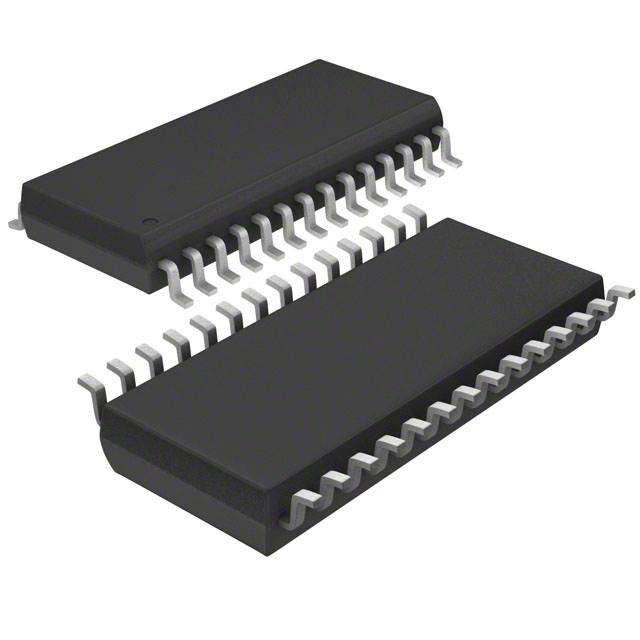
Engineered for the most demanding signal-acquisition environments, the ADS1282HPW is a high-temperature, ultra-high-resolution delta-sigma ADC from Texas Instruments' ADS1282-HT family. Categorized as a 31-bit, 2-channel analog-to-digital converter with an integrated low-noise programmable gain amplifier (PGA) and input multiplexer, this device is supplied in a TSSOP-28 (PW) package and is fully specified across the extreme temperature range of –55°C to 175°C for the PW package, making it a purpose-built solution for downhole drilling, seismic monitoring, and other high-temperature instrumentation where conventional silicon cannot survive[reference:0][reference:1]. By combining a fourth-order, inherently stable modulator with a flexible digital filter and a high-impedance PGA, the ADS1282HPW delivers laboratory-grade measurement integrity in environments that would otherwise require remote electronics or active cooling.
The core advantage of this high-temperature ADC lies in its exceptional resolution and linearity at elevated temperatures. The device achieves 130 dB SNR at 250 SPS in high-resolution mode, 124 dB SNR at 1000 SPS, total harmonic distortion of –122 dB, and integral nonlinearity of 0.5 ppm[reference:2][reference:3]. Unlike data converters that are only characterised at 25°C and derate unpredictably in hot environments, the ADS1282HPW is fully specified across its entire –55°C to 175°C operating window, with total power dissipation of just 25 mW and a shutdown current drawing only 10 µW[reference:4]. This combination of resolution, linearity, and thermal robustness eliminates the need for complex thermal management or signal-chain recalibration in downhole and geothermal tools.
At the heart of the ADS1282HPW is a fourth-order delta-sigma modulator paired with a low-noise PGA featuring 5 nV/√Hz input-referred noise and high input impedance, enabling direct interfacing to geophones and hydrophones across a wide range of gains without external preamplification[reference:5]. The two-channel input multiplexer provides an additional external measurement input as well as internal self-test connections, while the flexible digital filter chain offers selectable Sinc, FIR, and IIR responses with linear or minimum phase characteristics. Selectable FIR data rates span 250 SPS to 4 kSPS, and a programmable high-pass filter with adjustable corner frequency allows DC and low-frequency drift to be rejected in seismic and vibration sensing applications[reference:6]. A filter bypass option is also provided for users who prefer external post-processing.
The device is equipped with comprehensive calibration and synchronisation features as standard. An on-chip offset and gain calibration engine supports system-level correction, while the SYNC input allows multiple ADS1282 converters to be synchronised for multi-axis seismic arrays or distributed sensor networks[reference:7][reference:8]. The modulator is inherently stable and includes fast-responding over-range detection, ensuring predictable recovery from input overdrive conditions-a critical requirement in field-deployed instrumentation subjected to impulsive events. The analog supply accepts unipolar +5 V or bipolar ±2.5 V, and the digital supply operates from 1.75 V to 3.3 V, simplifying interfacing to low-voltage FPGAs and microcontrollers[reference:9].
The ADS1282HPW operates with an analog supply of +5 V (unipolar) or ±2.5 V (bipolar) and a digital supply of 1.75 V to 3.3 V. Its PW (TSSOP-28) package is fully specified for operation from –55°C to 175°C, while the die and KGD options extend the ceiling to 210°C for the most extreme applications[reference:10][reference:11]. The device is offered with controlled baseline, single assembly/test site, and single fabrication site, providing the traceability and change notification required for high-reliability and extended-lifecycle programs. The component is RoHS compliant with a NiPdAu lead finish and is classified under EAR99 for export control.
Product variant comparison - The ADS1282 family is offered in multiple orderable variants that differ primarily in temperature grade and package qualification. The ADS1282HPW (ordering code ADS1282HPW) is the high-temperature HT variant in the TSSOP-28 (PW) package, specified from –55°C to 175°C. The standard industrial ADS1282IPW shares the same TSSOP-28 footprint and 31-bit core, but is fully specified only from –40°C to 85°C (with a maximum operating range to 125°C), making it unsuitable for sustained operation in downhole or geothermal environments[reference:12]. The ADS1282HKGD and ADS1282HJDJ variants extend operation to 210°C for die and ceramic package options. The following table summarises the key differentiators among ADS1282 orderable variants:
Table 1: ADS1282 family orderable variants – temperature specification and package comparison
|
Parameter
|
ADS1282HPW (HT)
|
ADS1282IPW (Industrial)
|
ADS1282H (KGD/JDJ)
|
|
Temperature Specification
|
–55°C to 175°C
|
–40°C to 85°C (max. 125°C)
|
–55°C to 210°C
|
|
Package
|
TSSOP-28 (PW)
|
TSSOP-28 (PW)
|
KGD / CDIP (JDJ)
|
|
Resolution
|
31-bit
|
31-bit
|
31-bit
|
|
Input Channels
|
2 (MUX)
|
2 (MUX)
|
2 (MUX)
|
|
Max Data Rate
|
4 kSPS
|
4 kSPS
|
4 kSPS
|
|
SNR (250 SPS)
|
130 dB
|
130 dB
|
124 dB (1000 SPS)
|
|
PGA Noise
|
5 nV/√Hz
|
5 nV/√Hz
|
5 nV/√Hz
|
|
Power Dissipation
|
25 mW
|
25 mW
|
25 mW (210°C)
|
For replacement considerations, the ADS1282HPW is pin-compatible with the ADS1282IPW, enabling a direct board-level migration path when a design needs to move from industrial to high-temperature operation. Designers whose systems remain below 125°C may select the ADS1282IPW for cost and availability advantages, while those pushing beyond 175°C must migrate to the KGD or ceramic JDJ options. Within TI's broader precision converter portfolio, the ADS1281 offers a similar 31-bit core without the integrated PGA for applications where external amplification is preferred[reference:13]. All TSSOP-28 variants share the same footprint and pin configuration, allowing thermal-grade changes without PCB re-layout.
Common application scenarios for this high-temperature delta-sigma ADC include downhole drilling and measurement-while-drilling (MWD) tools, seismic monitoring and energy exploration, high-accuracy industrial instrumentation, geothermal well logging, and high-temperature test and measurement systems[reference:14]. Typical use cases involve digitising geophone and hydrophone outputs in borehole seismic arrays, acquiring strain and vibration data in downhole tools where ambient temperatures routinely exceed 150°C, and synchronising multiple converter channels for multi-axis seismic imaging. The device's 5 nV/√Hz PGA noise and high input impedance allow direct sensor connection, while the SYNC input enables deterministic sampling across distributed arrays. Thanks to its 130 dB SNR, 31-bit resolution, flexible digital filtering, and fully specified –55°C to 175°C operation in a TSSOP-28 package, the ADS1282HPW has become a trusted choice for engineers seeking a rugged, high-precision delta-sigma ADC-one that delivers the measurement fidelity of a laboratory instrument in the most hostile thermal environments, all while maintaining the pin compatibility and integration simplicity that accelerate high-temperature system development.