
1. What Defines an Automotive-Grade Chip?
The term "automotive-grade" carries a precise technical meaning within the semiconductor supply chain-it separates AEC-Q100 qualified integrated circuits from commercial or industrial parts. The Automotive Electronics Council (AEC), originally established by Chrysler, Ford, and General Motors in the 1990s, created the AEC-Q100 standard to establish a common qualification and quality system for automotive components.
An automotive-grade semiconductor is an integrated circuit that has passed the failure-mechanism-based stress tests defined by the AEC-Q100 standard. Qualification confirms that the device-not merely a product family-can withstand extreme temperature swings, high humidity, and electrical noise sufficiently to deliver field reliability across the full automotive lifecycle. Compliance is self-declared by the manufacturer and documented through a Production Part Approval Process (PPAP) package, rather than validated by a central certification body.
In contrast, a commercial-grade chip (also referred to as consumer-grade) is designed for consumer electronics such as smartphones, laptops, and household appliances. These devices operate in controlled indoor environments, prioritize cost and rapid iteration, and are validated under limited test conditions.
2. The AEC-Q100 Standard: Qualification Framework
AEC-Q100 is not merely a specification document-it embodies a reliability philosophy rooted in prevention, statistics, and failure mechanism physics. The standard's core principle is "failure mechanism based stress test qualification," ensuring that integrated circuits maintain high quality and reliability in demanding automotive environments.
2.1. Test Groups and Coverage
To achieve AEC-Q100 qualification, a chip must pass 41+ tests across 7 test groups. These groups comprehensively evaluate every aspect of device reliability:
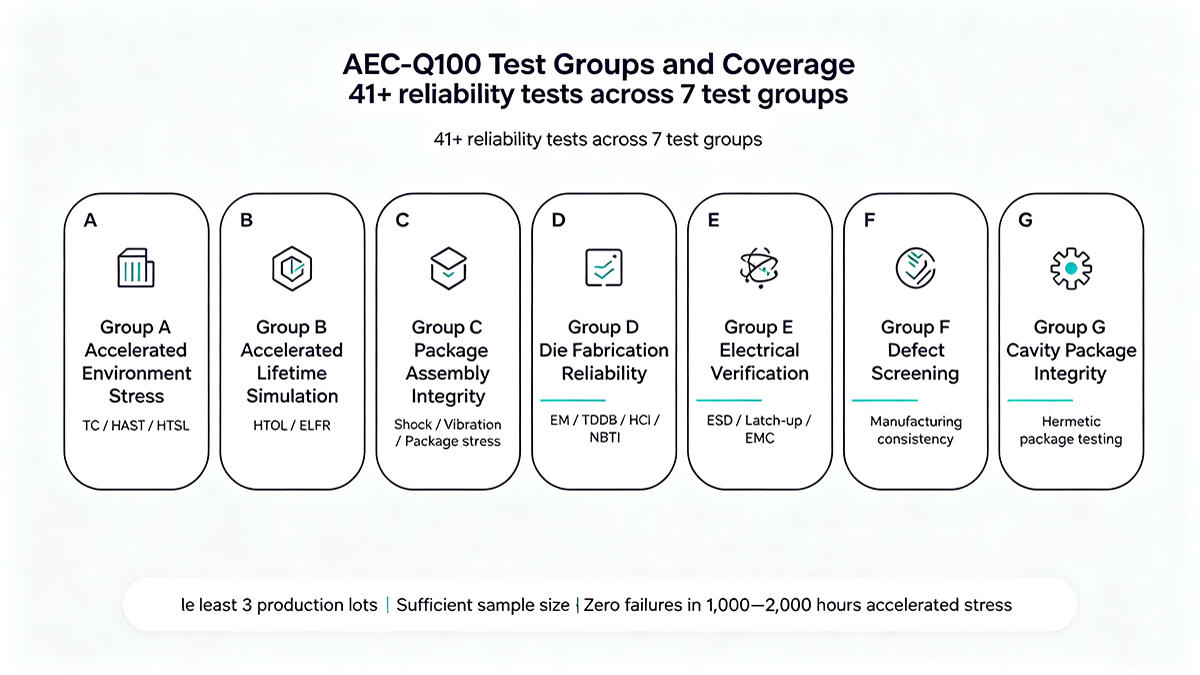
- Group A – Accelerated Environment Stress: Simulates extreme temperature, humidity, and thermal cycling conditions-including Temperature Cycling (TC), High-Accelerated Stress Test (HAST), and High-Temperature Storage Life (HTSL).
- Group B – Accelerated Lifetime Simulation: Evaluates long-term operational reliability through High-Temperature Operating Life (HTOL) and Early Life Failure Rate (ELFR) tests.
- Group C – Package Assembly Integrity: Verifies mechanical robustness against shock, vibration, and package stress.
- Group D – Die Fabrication Reliability: Assesses wafer-level reliability including electromigration (EM), time-dependent dielectric breakdown (TDDB), hot carrier injection (HCI), and negative bias temperature instability (NBTI).
- Group E – Electrical Verification: Covers 11 tests including ESD (HBM/CDM), latch-up, electromagnetic compatibility (EMC), and characterization.
- Group F – Defect Screening: Ensures manufacturing consistency and screens out latent defects.
- Group G – Cavity Package Integrity: Tests hermetically sealed packages for automotive applications.
Qualification requires testing across at least three independent production lots, with each lot requiring sufficient sample sizes (many tests require 77 samples per lot) to achieve statistical significance at extremely low failure rates. Samples must achieve zero failures across 1,000 to 2,000 hours of accelerated stress testing.
2.2. Temperature Grades
AEC-Q100 defines four ambient operating temperature grades, allowing designers to select components matched to their specific thermal environment:
| Grade | Temperature Range | Typical Applications |
|---|---|---|
| Grade 0 | -40°C to +150°C | Engine Control Units (ECUs), powertrain, engine compartment |
| Grade 1 | -40°C to +125°C | Under-hood environments, ADAS, chassis power domain ECUs |
| Grade 2 | -40°C to +105°C | Body control modules, HVAC systems, mid-level automotive electronics |
| Grade 3 | -40°C to +85°C | Interior electronics, infotainment, less heat-intensive applications |
The jump from Grade 2 (105°C) to Grade 1 (125°C)-a seemingly modest 20°C difference-represents an exponential challenge in reliability physics. Semiconductor failure mechanisms such as electromigration and hot carrier injection follow Arrhenius behavior, where temperature increases exponentially accelerate these potential failure modes.
3. Head-to-Head Comparison: Automotive vs. Commercial Chips
The differences between automotive and commercial chips extend across every dimension of device specification, from operating conditions to failure rates to supply chain commitments.
| Parameter | Automotive-Grade (AEC-Q100) | Commercial-Grade |
|---|---|---|
| Operating Temperature Range | -40°C to +125°C (Grade 1) or +150°C (Grade 0) | 0°C to +70°C |
| Defect Rate (PPM) | < 1 ppm | 300–500 ppm |
| Failure Rate (FIT) | < 1 FIT (one failure per billion hours) | Not specified; significantly higher |
| Design Lifecycle | 15+ years / 200,000 km | 2–5 years |
| Supply Chain Commitment | 15–20 years guaranteed supply | 3–5 years typical |
| Qualification Tests | 41+ tests across 7 groups (AEC-Q100) | Limited environmental and reliability testing |
| Functional Safety | ISO 26262 (ASIL-A to ASIL-D) | Not required |
| Quality Management | IATF 16949 | ISO 9001 or equivalent |
| ESD Qualification | HBM ≥2kV, CDM ≥1kV (AEC-Q100-011) | HBM ≥2kV typical; CDM often not required |
| Qualification Timeline | 2–3 years | Months |
3.1. Temperature Endurance: The First "Life-or-Death" Line
Automotive electronics must endure the double challenge of 60°C desert heat in Turpan and -40°C Arctic cold. Commercial-grade chips are designed for indoor comfort-typically 0°C to 70°C. When ambient temperatures exceed 60°C, commercial chip failure rates increase by 2.3%. In a vehicle, this directly translates to risks of panoramic display blackouts or system crashes.
Automotive-grade chips, by contrast, are validated to operate continuously for thousands of hours across -40°C to +125°C (Grade 1) or -40°C to +150°C (Grade 0) without failure. This extreme temperature tolerance is not optional-it is a fundamental requirement for components mounted near engines, in chassis compartments, or exposed to solar loading through windshields.
3.2. Defect Rates: Parts Per Million vs. Parts Per Billion
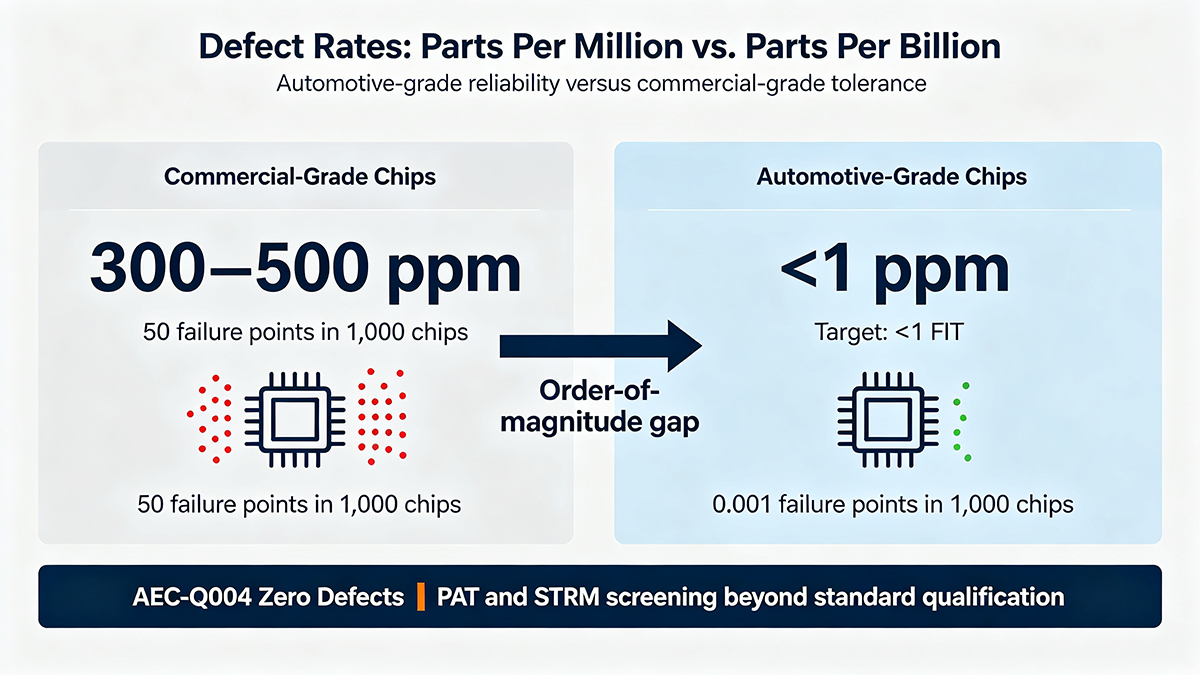
The defect rate gap between automotive and commercial chips is perhaps the most striking difference. Commercial-grade chips typically allow a defect rate of 300–500 ppm (parts per million). Automotive-grade chips require <1 ppm-and leading manufacturers target failure rates below 1 FIT (one failure per billion operating hours).
To put this in perspective: a modern intelligent vehicle may contain over 1,000 chips. A commercial-grade approach would potentially introduce 50 failure points (500 ppm × 1,000 chips), whereas an automotive-grade approach would yield just 0.001 failure points. This is not a statistical abstraction-it is the difference between a recall affecting hundreds of thousands of vehicles and a reliable fleet.
The AEC-Q004 "Zero Defects" framework guides suppliers toward this statistical reality, with top-tier manufacturers implementing per-lot screening methods such as Part Average Testing (PAT) and Short-Term Reliability Monitoring (STRM) that operate well beyond standard AEC-Q100 qualification requirements.
3.3. Lifecycle and Supply Chain: 15 Years vs. 2 Years
A vehicle is designed for a service life of 15 years or 200,000 km. Commercial consumer electronics-smartphones, tablets, laptops-are replaced every 2 to 5 years. This fundamental timeline mismatch creates profound supply chain implications.
Automotive chip suppliers must guarantee 15 to 20 years of continuous supply. STMicroelectronics recently extended its supply guarantee for automotive microcontrollers from 15 to 20 years. In contrast, many commercial-grade chips remain in production for only 3 to 5 years before reaching end-of-life.
This long-term commitment extends beyond the chip itself-it requires dedicated production lines, stringent process control, and IATF 16949 quality management certification. Suppliers must maintain batch traceability and consistency across years of production, a level of discipline that commercial supply chains rarely require.
4. Functional Safety: ISO 26262 and ASIL Levels
Beyond AEC-Q100 reliability qualification, automotive chips destined for safety-critical applications must meet ISO 26262 functional safety standards. This standard defines the Automotive Safety Integrity Level (ASIL) from A (lowest) to D (highest), determined by three risk parameters: severity (S), exposure (E), and controllability (C).
Safety-critical systems demand the highest ASIL levels:
- ASIL-D: Airbags, anti-lock braking systems (ABS), electronic power steering-requiring nanosecond-level response determinism and failure rates below 10⁻⁸ per hour.
- ASIL-B/C: ADAS and automated driving control systems.
- ASIL-A: Less critical functions such as interior lighting and infotainment.
Commercial-grade chips are not designed to ISO 26262-they lack the hardware-level redundancy (such as dual-core lockstep architectures), ECC memory, and systematic failure mode analysis (FMEA) required for ASIL compliance.
5. ESD Qualification: Higher Thresholds for Automotive
Integrated circuits destined for automotive applications face significantly higher electrostatic discharge (ESD) qualification requirements than commercial counterparts. Automotive-grade chips must pass three core ESD tests covering different electrostatic scenarios:
- Human Body Model (HBM): Simulates static discharge from human handling-automotive typically requires ≥2kV, with some applications up to 8kV.
- Charged Device Model (CDM): Simulates charge accumulation within the package during assembly-automotive requires ≥1kV.
- Machine Model (MM): Less commonly used but still specified in some automotive qualifications.
Commercial-grade chips typically require HBM ≥2kV but often do not mandate CDM testing. The additional CDM requirement is critical because automotive assembly environments present unique ESD risks that can damage chips during PCB mounting and module integration.
6. The Cost and Timeline of Automotive Qualification
The rigorous requirements of automotive qualification come with significant cost and time penalties:
- Qualification timeline: A complete AEC-Q100 qualification typically takes 2 to 3 years. This includes design for reliability, multiple production lots, 41+ tests across 7 groups, and documentation of PPAP packages.
- Cost impact: Certification fees alone increase chip design costs by approximately 30%. Higher material standards and tighter process controls further elevate manufacturing costs.
- Performance trade-off: By the time an automotive chip completes qualification, it may be 2–3 generations behind commercial counterparts in terms of raw performance-most automotive chips still use 20nm+ mature process nodes.
This timeline-performance trade-off has created tension in the industry. As vehicles demand increasing compute power for autonomous driving and advanced infotainment, some manufacturers have explored using commercial-grade chips for non-critical functions. However, industry consensus-reinforced by automakers like Audi-holds that safety-critical systems must remain strictly automotive-grade.
7. Application Mapping: Where Each Grade Belongs
The choice between automotive and commercial grades is not binary-it depends on the specific application's safety criticality and environmental exposure:
| Application Domain | Required Grade | Rationale |
|---|---|---|
| Engine Control Units (ECUs) | Automotive Grade 0 | Engine compartment temperatures up to 150°C; safety-critical |
| ADAS / Autonomous Driving | Automotive Grade 1 + ISO 26262 (ASIL-B/D) | Under-hood temperatures; real-time safety decisions |
| Braking / Steering / Airbags | Automotive Grade 1 + ISO 26262 ASIL-D | Life-critical systems; nanosecond response required |
| Body Control Modules | Automotive Grade 2 | Moderate temperature exposure; non-critical timing |
| Infotainment / Displays | Automotive Grade 3 (or commercial in some cases) | Interior, controlled environment; less safety-critical |
| Consumer Electronics | Commercial Grade | Indoor, controlled environment; short lifecycle |
8. Selection Checklist for Automotive Chip Procurement
- Verify the exact orderable part number suffix-automotive variants carry specific suffixes (e.g., -Q1 for TI).
- Confirm the datasheet's temperature grade (Grade 0/1/2/3) matches your application's thermal environment.
- Request AEC-Q100 qualification summaries and PPAP documentation from the supplier.
- Verify ISO 26262 ASIL certification for safety-critical applications (ASIL-A through ASIL-D).
- Confirm the supplier's long-term supply commitment-minimum 15 years for automotive programs.
- Validate ESD qualification-HBM ≥2kV and CDM ≥1kV for automotive-grade ICs.
- Ensure the manufacturing facility follows IATF 16949 quality management and dedicated automotive production lines.
- Request lot traceability and Part Average Testing (PAT) data for quality assurance.
- Consider the qualification timeline-automotive chips typically require 2–3 years from design to production release.
- For non-critical interior applications, evaluate whether commercial-grade with additional screening could meet requirements-but document the risk assessment thoroughly.
9. Frequently Asked Questions (FAQ)
Automotive-grade chips are qualified to AEC-Q100 standards, designed to operate across extreme temperature ranges (-40°C to +125°C or higher) with failure rates below 1 ppm and a 15+ year lifecycle. Commercial-grade chips typically operate from 0°C to +70°C, allow failure rates of 300–500 ppm, and have a 2–5 year lifecycle.
AEC-Q100 defines four grades: Grade 0 (-40°C to +150°C) for engine control units and powertrain; Grade 1 (-40°C to +125°C) for under-hood and ADAS systems; Grade 2 (-40°C to +105°C) for body control modules; and Grade 3 (-40°C to +85°C) for interior electronics and infotainment.
Commercial-grade chips typically allow a defect rate of 300–500 ppm (parts per million). Automotive-grade chips require defect rates below 1 ppm-and leading manufacturers target failure rates below 1 FIT (one failure per billion operating hours), as documented in TI functional safety white papers.
The cost premium stems from: AEC-Q100 qualification requiring 41+ tests across 7 test groups, taking 2–3 years; dedicated production lines with IATF 16949 quality management; extended temperature range materials; lower defect rates requiring tighter process controls; and 15+ year supply chain commitments.
For safety-critical systems (braking, steering, ADAS, airbags), commercial-grade chips are unacceptable-they lack the temperature range, failure rate, and functional safety (ISO 26262) qualifications required. For non-critical interior infotainment displays in controlled environments, some manufacturers have explored commercial-grade options, but this remains controversial and carries significant field failure risk.
10. Industry Trends and Market Outlook
The automotive semiconductor market continues to expand rapidly. According to TechInsights, the global automotive semiconductor market reached $74.4 billion in 2025, up from $69.9 billion in 2024, representing approximately 6.4% year-over-year growth. Infineon Technologies leads the market with approximately 12.8% share, followed by NXP, STMicroelectronics, Texas Instruments, and Renesas.
Key trends shaping the automotive chip landscape include:
- Power semiconductor dominance: Power devices account for 32% of the automotive semiconductor market, driven by 800V high-voltage platforms and SiC penetration exceeding 70%.
- Increasing chip content per vehicle: Electric vehicles now carry 3–4 times the semiconductor content of traditional internal combustion engine vehicles.
- Regional dynamics: The Asia-Pacific region accounts for 42–45% of the market, with China as the largest single market-though domestic self-sufficiency remains only about 18%.
- Supply chain resilience: The industry continues to face structural shortages, with supply constraints expected to persist through 2026.
- Extended supply guarantees: Major suppliers like STMicroelectronics have extended automotive MCU supply guarantees from 15 to 20 years.
11. Conclusion
The divide between automotive-grade and commercial-grade chips is not a marketing distinction-it is a fundamental engineering reality rooted in decades of reliability physics, rigorous qualification standards, and the unforgiving demands of automotive environments. AEC-Q100 qualification, ISO 26262 functional safety, and IATF 16949 quality management create a framework that ensures semiconductor reliability across 15+ years and 200,000 km of vehicle operation.
While commercial-grade chips offer higher performance at lower cost, they cannot match the temperature tolerance, defect rates, or supply chain longevity required for automotive applications. For safety-critical systems-braking, steering, ADAS, airbags-the choice is non-negotiable. For non-critical interior functions, the industry continues to debate the risk-reward trade-off, but the consensus remains clear: when human safety is at stake, only automotive-grade silicon is acceptable.
As vehicles become increasingly software-defined and semiconductor-dependent, understanding the distinctions between these grades becomes essential for every engineer, procurement professional, and decision-maker in the automotive supply chain.